Full-Grain Leather Belts Worth the Price
A belt is one of the few accessories where the material grade is the whole story. A good full-grain belt outlives the trousers it was bought with; a bonded-leather belt cracks at the crease within a few seasons. The trouble is that belt marketing uses the same words for completely different materials.
It is also a product where the worst materials wear the best vocabulary. A bonded strap can be labelled with words a tannery reserves for its top cut, and the buyer finds out when the crease cracks. The checks below take two minutes and sort the market cleanly.
Reading the grade honestly
“Full-grain” means the hide’s outermost layer, uncorrected, with the grain intact. It is the strongest cut and it patinas instead of peeling. “Top-grain” is the next layer down, sanded to remove imperfections — still a single piece of hide, slightly weaker. “Genuine leather”, despite sounding authoritative, is a catch-all term that can describe split leather pressed and finished to look whole.
Two honest signals: weight, because a substantial belt at one-piece thickness has to be full- or top-grain by physics; and the edge, because a belt with paint-thick edge coating is often hiding a split core.
Thickness is the third signal, and honest makers state it — usually in ounces, where one ounce of leather is roughly a sixty-fourth of an inch. A work-weight belt runs 10 to 12 ounces; a dress belt runs 6 to 8. A listing that gives no thickness and no cut is selling a width, not a construction. And a “full-grain” belt with a flawless, uniform surface is a contradiction: untouched grain carries range marks and small scars, because flaws cannot be sanded out of it.
Hardware and stitching
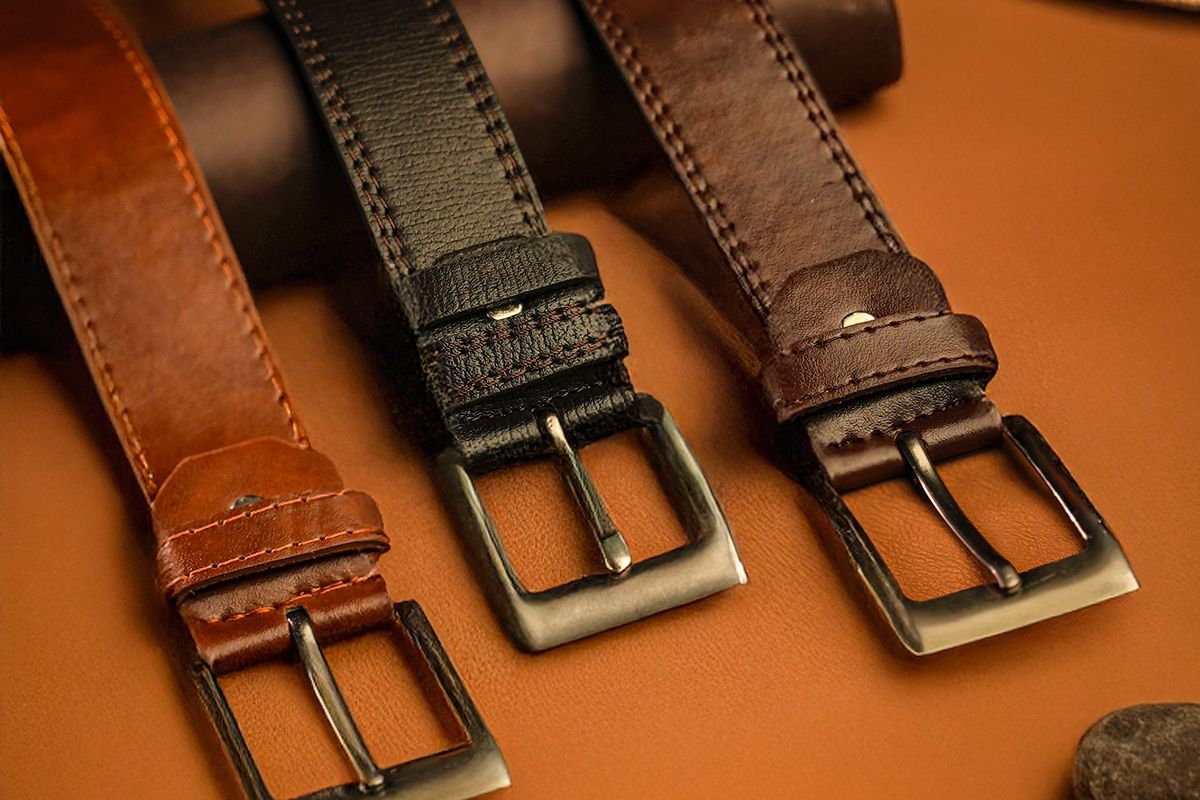
The buckle is where cheap belts fail second. Solid brass or stainless buckles — screw-attached rather than crimped — let you replace the buckle without replacing the belt. Look for nylon or polyester thread at the strap-to-buckle junction; cotton thread is the standard failure point on otherwise decent belts.
Metal choice is readable in photos. Solid brass and stainless take on patina and can bend back from a catch; zinc-alloy castings flake to pale grey and snap. A roller between buckle and strap saves the strap hole that wears through first. And the stitching at the junction should be even and synthetic — a loose or painted-over line of stitches is how a buckle separates from an otherwise good strap.
What the picks are picked for
All three makers below document their leather sourcing and construction on their own product pages, which is the transparency bar for a recommendation here. For how to keep one of these belts alive, our guide to conditioning leather without darkening it covers the routine, and leather grades without the marketing expands the grading vocabulary to bags.
The Orion Leather Full-Grain Belt is the reference pick: a one-piece strap with screw-set hardware, made by a small shop that states its leather weights and construction plainly. Nothing on it exists for the photograph, which is exactly why it lasts.
The Hanks Extreme Belt is overbuilt on purpose — a thick, heavy work-belt construction with a solid buckle and a Chicago-screw attachment, made for daily hard use. It is more belt than office trousers want, and the weight is the point.
The Anson Belt Buffalo Leather Strap solves a different problem: fit that survives a changing waistline. The brand documents vegetable-tanned full-grain buffalo leather, trim-to-fit sizing and a lifetime guarantee, and its Micradjust buckle tightens in small steps without punch holes. The trade-off is the look — a modern track mechanism instead of a punched heritage belt.
The picks
Some links below are affiliate links — we may earn a commission at no extra cost to you.
- 1
Orion Leather Full-Grain Belt — Best overall
A one-piece full-grain belt with screw-set hardware, made by a small shop that states its leather weights and construction on the product page. The plainness is the point.
Check current price - 2
Hanks Extreme Belt — Toughest build
A thick, heavy work-belt construction with a solid buckle and Chicago-screw attachment. Overbuilt for office wear; the pick if the belt sees daily hard use.
Check current price - 3
Anson Belt Buffalo Leather Strap — Best for adjustable fit
Vegetable-tanned full-grain buffalo with a Micradjust track buckle that dials the fit in without punch holes, and the strap trims to size. Trade-off: modern track hardware skips the punched, heritage look.
Check current price
Comparison
| Orion Leather | Hanks Extreme | Anson Belt | |
|---|---|---|---|
| Best for | Everyday wear | Hard daily use | Changing waistlines |
| Profile | Classic width | Wide, heavy | Standard, trim-to-fit |
| Buckle attachment | Screw-set | Screw-set (Chicago screws) | Micro-adjust track |
| Character with age | Patinas visibly | Darkens and hardens | Patinas slowly |
FAQ
- What is the difference between full-grain and genuine leather belts?
- Full-grain leather keeps the outermost layer of the hide, which is the strongest. Genuine leather is a grading term that often describes corrected or split leather, not a quality tier — it can be the weakest cut in the hide.
- How long should a good leather belt last?
- A full-grain belt with quality hardware can last a decade or more of regular wear. Bonded or split-leather belts typically fail at the crease point within a few years.
- What size belt should I order?
- Belt size is usually two to four inches above your pant waist size, and sizing varies by maker. Order from the maker's own measurement chart measured at the buckle fold to the middle hole, not from pant size alone.